Wednesday, August 8, 2018

Bob Seger - Detroit Made


Some people collect cars. I do too, but instead of restoring three to four thousand pounds of sheet metal, I collect videos for my driver's ed students.


More to come...Suggestions?

How about this adaptation from American Graffiti! Do you remember when we used to cruise the Ave?


Hot Rod Lincoln Originally released in 1960 by Charlie Ryan and the Timberline Riders. I like to show this version by Commander Cody and His Lost Planet Airmen.


Elvis bought a Pink Cadillac for his mom. When I went to look up this tune, I found one by Jerry Lee Lewis and  one by Bruce Springsteen. So...why is the Cadillac black?


Low Rider has been used in 17 Films starting with Up In Smoke.


Freedom of the road...Born to be Wild!


Kinda like radar love?


Tuesday, August 7, 2018

How to Turn - Vision (the most important thing)


Every time I share this with my students, the light goes on. They've been looking down the hood with their parents trying to give instructions like turn more or turn less. If the student uses their eyes, they will be able to turn smoothly. If they bring their eyes up and look down the path of travel, the car will follow.

And what about Tailgating?


Sunday, July 22, 2018

Saudade

Loss From Something Gained

When I started the journey to find out more about myself, I was hoping to gain insight into a family health history that was totally absent. I had an outside hope for connections, but they weren't expected.
There were times in my life when people used my adoption as a weapon. They said things that were hurtful. At times intentionally, at other times unintentionally. They were meant to put me in my place.
Hearing from my half bother Gary Mantalas last spring was out of the blue. To suddenly find four half-siblings was unexpected. There was suddenly a connection that had not been there before.
After a few phone conversations with Gary, he decided it was time to meet him and his two brothers. They were planning a road trip her in October. We were all looking forward to getting to know each other better.
Yesterday I learned of Gary's unexpected death. I know we've never met, but I still feel the loss. I also sense the loss my bothers and sisters and his children must be feeling right now. I can take consolation in having found Gary and a family that was unknown to me for 68 years. My heart goes out to them.
There's an untranslatable word in Portuguese that expresses the feeling of loss and ,perhaps, lends some perspective,
Saudade.
I found this explanation by Laurie Burrows Grad.
Saudade is a Portuguese expression that is almost untranslatable. The best way to describe it is: the presence of absence. It is a longing for someone or something that you remember fondly but know you can never experience again. It is an awareness of the absence of a person or thing, which puts you in a deep emotional state of sadness. The presence of absence grapples with those who should be here but aren’t. It is a form of homesickness and deep yearning. You are among thousands of people but none is the one you want to be by your side. Saudade is the moment you realize how important people are in your life and the moments you have taken for granted.
But there is something to hold onto.
Saudade is not nostalgia where you reminisce about happy and sad emotions. You remember the happiness but feel the sadness knowing you can’t recapture the feeling. Nostalgia expresses a sensation one has for a loved one who has died while saudade is the knowledge that some one is absent from my life. Saudade provides comfort because even in my sorrow, I sometimes feel an incongruous rush of joy in the hope of recovering something that will fill the presence of their absence.

Wednesday, June 20, 2018

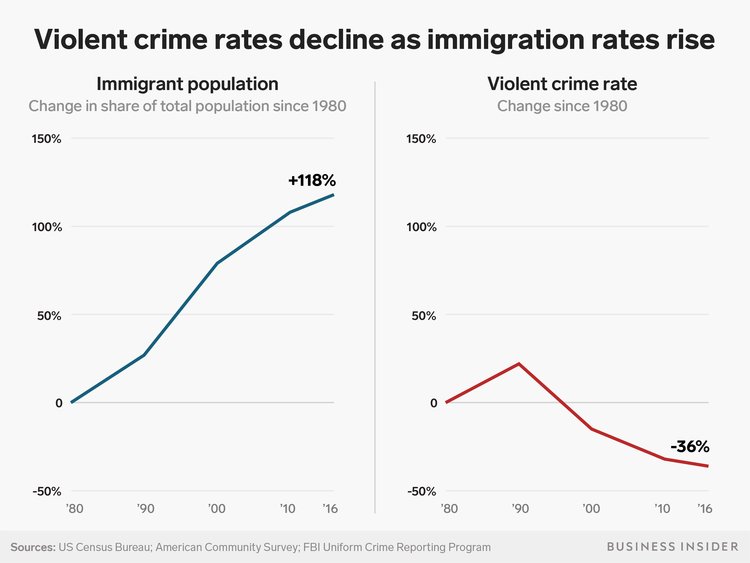
Crime Rates Among Immigrants Are Low


There's a claim that immigrants are bringing high crime rates. The United States is being infested with criminals


'They're bringing drugs,' crime and are 'rapists' -Trump

"These aren't people, these are animals."  -Trump

Is it Irrational Fear? Is it political posturing? It is demonstrably false.


There's even a claim that the crime rates are way up in Germany. That's false too. According to a report published by Politifact, According to the latest government numbers that came out in May, crime in the European Union’s largest economy is down by about 9.6 percent from 2016 to 2017.  


It is also down nearly 4 percent compared to 2012. This chart shows the percentage drop in all crime, violent crime, and the three most common crimes of street crime (a catchall category that spans offenses from sexual harassment to extortion to gang violence), theft and property damage.


An article in Vox by Matthew Yglesias contends Trump's cruel immigration politics is a scam. His approach is based on big lies. Keeping immigrants out will not make us all richer and safer.

Saturday, May 12, 2018

Human Toll of Air Pollution

Easing the Standards


The EPA wants to ease the standards on air pollution. The reasoning is the standards get in the way of economic growth, but there's a trade off.  There's a cost much greater than the cost of clean air standards impose on industry.


According to the World Bank...


Air pollution costs the global economy more than $5 trillion annually in welfare costs, with the most devastating damage occurring in the developing world, according to a new World Bank report. The welfare figure incorporates a number of costs associated with air pollution like health and consumption.Sep 9, 2016


Bad air also costs lives...


Monday, April 30, 2018

Replace Poverty with Hope

Poverty Can Be Beaten

Not all at once. And poverty will always be with us, but there is a way out if we can offer hope.  Access to good schools, healthcare, electricity and safe water are among some of the basics needed to help people move out of poverty.
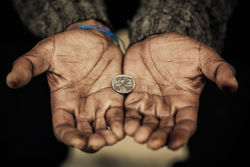


"People who believe in their futures are more likely to invest in those futures (for instance going back to school to get a job credential or following good preventive health practices) and to have better outcomes. The hope channel is particularly important for individuals with less means, for whom making such investments requires greater trade-offs. If they do not believe these investments will pay off, then they are much less likely to make them." Carol Graham - The Loss of Hope in Low Income America


The absence of hope defines true poverty

How Many?

Nearly 1/2 of the world's population — more than 3 billion people — live on less than $2.50 a day. More than 1.3 billion live in extreme poverty — less than $1.25 a day. 1 billion children worldwide are living in poverty. According to UNICEF, 22,000 children die each day due to poverty.

45 Million Americans Still Stuck Below Poverty Line: Census. 

Despite five years of economic recovery, poverty is still stubbornly high in America. More than 45 million people, or 14.5 percent of all Americans, lived below the poverty line last year, the Census Bureau reported on Tuesday.Sep 16, 2014


Declining Numbers

The numbers in the United States declined in 2015 and 2016 as the economy grew. According to the US Census Bureau:

  • The official poverty rate in 2016 was 12.7 percent, down 0.8 percentage points from 13.5 percent in 2015. This is the second consecutive annual decline in poverty. 

  • Since 2014, the poverty rate has fallen 2.1 percentage points from 14.8 percent to 12.7 percent. 

  • In 2016 there were 40.6 million people in poverty, 2.5 million fewer than in 2015 and 6.0 million fewer than in 2014. 
  • The poverty rate in 2016 (12.7 percent) was not significantly higher than the poverty rate in 2007 (12.5 percent), the year before the most recent recession. 
These are just numbers. They suggest that if we throw money at the problem all will be well. Poverty is a lot more than a lack of income. True poverty is the absence of hope. It is despair and misery because there seems to be no way out.


The Loss of Hope in Low-Income America

Carol Graham is a Senior Fellow at the Brookings Institution and a Professor at the University of Maryland. She recently wrote a book, “Happiness for All? Unequal Hopes and Lives in Pursuit of the American Dream,” published by Princeton University Press.


Her research uncovered a growing number of poor whites living in true poverty. Her work shows that poor whites have very little hope for the future on one hand, and high levels of stress, worry, and anger on the other. The lack of hope is manifesting itself in increasing isolation and poor health and preventable deaths (such as suicide, opioid overdose, and alcohol poisoning). It is because the American Dream no longer seems attainable. Growing income inequality is a root cause.

The World Bank's View

According to the World Bank, moving out of poverty means, "access to good schools, healthcare, electricity, safe water and other critical services remains elusive for many people, often determined by socioeconomic status, gender, ethnicity, and geography. Moreover, for those who have been able to move out of poverty, progress is often temporary: economic shocks, food insecurity and climate change threaten to rob them of their hard-won gains and force them back into poverty. "

The Cost


The cost of child poverty: $500 billion a year in the U.S. 

The United States has the second-highest child poverty rate among the world's richest 35 nations, and the cost in economic and educational outcomes is half a trillion dollars a year, according to a new report by the Educational Testing Service. Jul 25, 2013

About 15 million children in the United States – 21% of all children – live in families with incomes below the federal poverty threshold, a measurement that has been shown to underestimate the needs of families. Research shows that, on average, families need an income of about twice that level to cover basic expenses. (National Center for Children in Poverty)


Is It A Big Deal?

Yes! According to Global Issues, "Poverty is the state for the majority of the world's people and nations. ... Such causes of poverty and inequality are no doubt real. But deeper and more global causes of poverty are often less discussed. Behind the increasing interconnectedness promised by globalization are global decisions, policies, and practices."

Return the hope for a better future and people will work themselves out of despair. The beginning of new hope comes from listening to those who are living it.  From there... positive messages and increasing inclusiveness...not division.


Sunday, April 22, 2018

Rents Are Up...Income Is Not

Household Income Not Keeping Pace

Pew Research and APM's Marketplace are reporting that household income is not keeping pace with increases in rent. According to Pew, after the recession of 2007 - 2009 fewer people were able to transition from rentals to home ownership. Add to that the influx of millennials into the workforce increasing the demand for rentals, and the supply of rentals is down while demand is up.


The Rent Is Too Damn High


Millennials are taking a double whammy. Home prices stagnated and fell during the recession and its aftermath have rebounded to the higher prices seen during the bubble of 2007. Millenials are priced out of the market. Millennials aren't the only demographic facing the financial pinch.


American Families Face a Growing Rent Burden


17 million are rent burdened and the numbers keep going up. Rent Burdened is defined by HUD as cost-burdened families. Those “who pay more than 30 percent of their income for housing” and “may have difficulty affording necessities such as food, clothing, transportation, and medical care.” Severe rent burden is defined as paying more than 50 percent of one's income on rent.


The Pew study finds 38 percent of all renter households are burdened. Severely rent burdened households—spending 50 percent or more of monthly income on rent—increased by 42 percent. It is now 17% of all renters.


The chart below demonstrates that the problem has been getting worse since 2001.


Less Disposable Income

Households that are rent burdened have fewer dollars to spend. They often make choices between healthcare, food and education. 
According to Pew's findings:
Rent-burdened families are also financially insecure in many other ways:
  • Nearly two-thirds (64 percent) had less than $400 cash in the bank; most (84 percent) of such households are African-American-headed.
  • Half had less than $10 in savings across various liquid accounts, while half of homeowners had more than $7,000.

The growing disparity is leading to a growing underclass that is on the outside looking in with little hope of reversing their situation.  Our economy is stronger when our citizens are able to participate as individuals and as consumers. Keeping large portions of the population on the outside will only further divide us. 


And there's a growing cost of poverty. The cost of child poverty: $500 billion a year. The United States has the second-highest child poverty rate among the world's richest 35 nations, and the cost in economic and educational outcomes is half a trillion dollars a year, according to a new report by the Educational Testing Service.